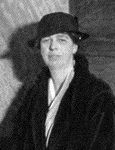
Roosevelt became governor of New York in 1929 with Eleanor beside him. A brief four years later, the Roosevelts were in the White House where Eleanor became a most active, visible, and influential presidential spouse. During her tenure as First Lady, Eleanor Roosevelt championed the cause of the less fortunate. She traveled to prisons, mines, hospitals, and tenements. She was an active proponent of her husband's New Deal and became known as his "eyes and ears" as she traveled around the Depression-era U.S.
It is estimated that she traveled over 40,000 miles each year as First lady.
Among her achievements as First Lady was the establishment of the National Youth Administration. She also revitalized Ellen Wilson's slum clearance program with the Alley Dwelling Act of 1934. She invited Marian Anderson, a black contralto, to sing at the White House in 1936. In 1939, the Daughters of the American Revolution refused to let Miss Anderson sing at Constitution Hall; Eleanor Roosevelt promptly resigned from the organization and arranged for the singer to perform at the Lincoln Memorial.
Mrs. Roosevelt penned a daily newspaper column, "My Day" to express her opinions. During the Second World War, she visited army bases all over the world. She was voted one of America's most admired women year after year. Eleanor Roosevelt had become an American institution.
After Franklin Roosevelt's death in April 1945, she asked Harry Truman, "Is there any way we can help you?" Within a week, she had left the White House. But her work was not yet nearly over. President Truman made her a delegate to the fledgling United Nations in 1946. There, she became chairman of the Human Rights Commission. Eleanor Roosevelt turned down several offers to run for political office, preferring to remain free to express her opinions as she saw fit.
She was, however, a force in the Democratic party throughout the 1950s. Upon her death in 1962, the world knew that it had lost a unique individual. In the words of Winston Churchill, "she left golden footprints behind."