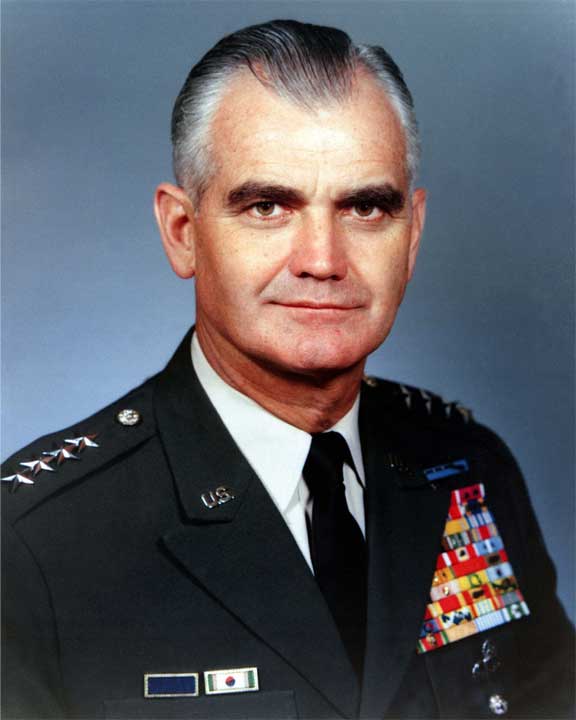
William Westmoreland was the American general who commanded United States forces during the crucial escalation years of the Vietnam War, becoming the public face of an increasingly unpopular conflict. Born in South Carolina, he graduated from West Point in 1936 and served with distinction as an artillery officer in North Africa, Sicily, and Europe during the Second World War, and later in Korea.
A model of military bearing and ambition, Westmoreland rose rapidly through the ranks and in 1964 was placed in command of American forces in Vietnam. Over the next four years he presided over a massive buildup, eventually leading more than half a million troops, and pursued a strategy of attrition — using superior firepower and search-and-destroy operations to wear down the enemy and measuring progress by "body counts."
For a time he assured the American public that the war was being won and that the "end was coming into view." Then, in early 1968, the enemy's Tet Offensive — though a military defeat for the communists — shattered confidence in those optimistic claims and turned American opinion sharply against the war.
Westmoreland was recalled to Washington and promoted to Army Chief of Staff. His reputation remained bound to Vietnam; years later he sued a television network over a documentary about the war, settling the case before its conclusion. He died in 2005, a figure forever associated with America's most divisive war.