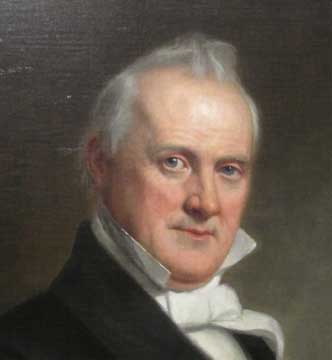
In office March 4, 1857 — March 4, 1861 · Democratic
As the Union fractured over slavery, Buchanan insisted he had no power to stop secession. Seven states left before he handed Lincoln a nation already coming apart — and history's verdict on him has been harsh. Elected 1856 →
Born
Apr 23, 1791Cove Gap, PA
Died
June 1, 1868Lancaster, PA
Party
Democratic
Vice President
John C. Breckinridge
First Lady
Harriet Laneniece, as hostess
War
None
James Buchanan
James Buchanan, the only bachelor to be President, spent his entire term of office in an unusual attempt to maintain the integrity of the Union. By the time he left office, the secession of the Southern States was already in progress.
Watch — James Buchanan in brief
James Buchanan was born in a log Cabin at Cove Gap, a few miles outside of Mercerberg, Pennsylvania. At the age of five he and his family moved from the log cabin to Mercerberg. Buchanan received his initial education at the Old Stone Academy in Mercerberg. He went on to attend Dickinson College in Carlisle. He graduated in 1809 and moved to Lancaster to study law. He was admitted to the bar in 1812.
In October 1814, Buchanan was admitted to the Pennsylvania House of Representatives as a Federalist. In 1820 he was elected to the US House of Representatives. Buchanan emerged as a leading opponent of the policies of John Quincy Adams. He was an active supporter of Jackson's presidential campaign. From 1829-31, Buchanan was chairman of the House Judiciary Committee. In 1830, Buchanan declined to run for re-election, preferring to return to his law practice. From 1832-33, he served as the US Ambassador to Russia, where he successfully concluded a commercial treaty.
From 1834-1845, Buchanan served in the US Senate. From 1837, he served as chairman of the Senate Foreign Relations Committee and from 1945, for four years, he was US Secretary of State. In 1848, Buchanan was a candidate for the Democratic presidential nomination. When he was not selected, he supported his opponent, Lewis Cass, who lost the election. In 1852, he was once again a contender for the nomination, lost again, and this time the winner he supported - Franklin Pierce - was elected. Pierce appointed Buchanan Ambassador to Great Britain.
Accomplishments in Office
Buchanan's administration was overwhelmed almost immediately by the brewing storm of the Civil War. Days after he was sworn in, the Supreme Court handed down the Dred Scott decision, denying the right of a black person to sue on the grounds that the constitution did not protect blacks. This decision supported Buchanan's view that the Constitution supported slavery and that, although he personally opposed it on moral grounds, there was little that he could or would do given his and the Supreme Court's reading of the Constitution.
Buchanan was in favor of admission of Kansas as a slave state but, in 1861, Kansas was admitted as a free state. This split his party and, after Lincoln's election, Buchanan stood by helplessly as Southern States seceded from the Union. He stated that on one hand the States had no right to secede, on the other hand there was nothing he, as a lame duck President, could do about it.
From the makers of HistoryCentral
Explore our history apps
Take HistoryCentral with you. Our apps put American history and centuries of the human story in your pocket.