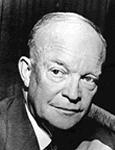
In office January 20, 1953 — January 20, 1961 · Republican
The supreme Allied commander who won World War II in Europe, Eisenhower brought the Korean War to a close, built the Interstate Highway System, and steered the nation through the early Cold War with steady restraint. Elected 1952 →
Born
Oct 14, 1890Denison, TX
Died
Mar 28, 1969Washington, D.C.
Party
Republican
Vice President
Richard Nixon
First Lady
MamieEisenhower
War
Korean War (ended)1953
The Early Years
Dwight Eisenhower was born in Dennison, Texas. He grew up in a poor family. He was educated in local public schools, and graduated from Abilene High School in 1909. Eisenhower was interested in attending the Naval Academy, but was told that he was too old (he had just passed his 20th birthday) and was ineligible. Instead, he went the US Military Academy at West Point. He was an average student, graduating 64th out of 164 students. Upon his graduation, Eisenhower was commissioned as a Second Lieutenant. He served throughout the war within the United States borders, rising to the temporary rank of lieutenant colonel. Between the World Wars, Eisenhower held various assignments, rising to the rank of Brigadier General in September, 1941. Soon after the Japanese attack on Pearl Harbor, Eisenhower was appointed Deputy Chief of Staff for war plans. He then became Chief of the General Staff - Operations Division. In June 1942, he was appointed Commander of US Forces in Europe. In that capacity, he led the US invasion of North Africa, Sicily, Italy, and then, finally, the US invasion of Normandy. Upon his return to the US in November 1945, he was named Army Chief of Staff. He resigned from the Army in 1948. From 1948 until 1950, he was President of Columbia University. From 1951 until 1953 he served as the first Commander of NATO.
Watch — Dwight D. Eisenhower in brief
Presidents Eisenhower's first task upon assuming office was to fulfill his campaign promise to end the Korean War. Within six months of his assuming office, an armistice agreement was signed. Eisenhower instituted a new military policy for the US Armed Forces. That policy was called the "New Look". It envisioned smaller conventional forces, backed up by massive nuclear deterrence. The assumption was that the United States would respond to any attack with nuclear weapons. In 1954, Eisenhower refused a request from the French for US intervention to save their troops fighting in Vietnam, at Dien Ben Phu. This refusal is widely thought to have dealt a final blow to the French as a force in Indochina, and altered the Allied relationship for all time. The death of Stalin in 1953 allowed for a reassessment of US-Soviet relations. In 1955, a summit meeting was held among the US, the British, the French and the Soviets. During the meeting, Eisenhower proposed the policy of "open skies". Under this program, the airspace of each country would be open to be photographed by the air force of the others. Eisenhower suffered a heart attack in 1955, which incapacitated him for over two months. In 1956, American pressure on the British and French forced their withdrawal from the Suez Canal that they had seized from Egypt. A few months later, Israel was forced to withdraw from the Sinai due to the same sort of pressure. In 1957, Eisenhower outlined what became known as the Eisenhower Doctrine, under which the United States would aid any country threatened by Communist aggression or subversion. The next year he dispatched troops to Lebanon to support a pro-Western government there. Near the end of his Presidency, an American U-2 spy plane was shot down over the Soviet Union, and its pilot captured. This put considerable strain on Soviet- American relations. Domestically, Eisenhower introduced the term Modern Republicanism. It was based on the idea of programs to help the poor and aged, while trying to limit the powers of central government. Under Eisenhower, Social Security and unemployment insurance were extended into additional millions. Simultaneously, Eisenhower attempted to direct many new initiatives in state and local governments. In two areas, Eisenhower substantially expanded the powers of the government. He was a vigorous supporter of the Federal Interstate Highway Program, whose aim was to connect the States through an integrated, contiguous highway program. Finally, Eisenhower decided to introduce Federal troops to implement the Brown vs. Board of Education landmark integration case. This put the Federal government in the forefront of the integration struggle. During the last year of the Eisenhower Presidency, especially during the second of Eisenhower's battles with physical illness, there was a feeling that the country was rudderless, and lacking a strong leader. The successful launch of Sputnik by the Soviets worried the American people, and led to a feeling that the United States was slipping as a world power. A year later, in his final speech, Eisenhower warned Americans about the dangers of the "military industrial complex."
From the makers of HistoryCentral
Explore our history apps
Take HistoryCentral with you. Our apps put American history and centuries of the human story in your pocket.