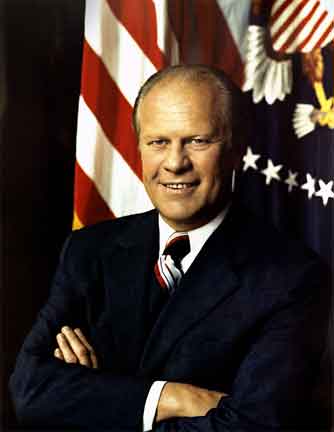
In office August 9, 1974 — January 20, 1977 · Republican
The only president never elected to the White House or the vice presidency, Ford took office on Nixon's resignation and tried to heal the nation by pardoning him — a decision that may have cost him the 1976 election.
Born
July 14, 1913Omaha, NE
Died
Dec 26, 2006Rancho Mirage, CA
Party
Republican
Vice President
Nelson Rockefeller
First Lady
BettyFord
War
Fall of Saigon1975
Gerald Ford
President Ford was the only President neither elected to the Presidency nor the Vice Presidency, Ford never recovered from his pardon of Nixon. During his Presidency Saigon fell to the Vietnamese, and economic conditions in the US worsened.
Watch — Gerald Ford in brief
Gerald Ford was born in Omaha, Nebraska. Soon after Ford's birth, his biological father left his mother. His mother remarried, and her new husband adopted her son.
Ford attended public schools in Grand Rapids. He graduated in the top five percent of his class. Ford went on in 1931 to attend the University of Michigan. He was a B student but became an outstanding football player and was offered professional football contracts. Ford declined because of his desire to go to law school. In 1935 he was hired to be an assistant football and head boxing coach at Yale University. In 1938 he was allowed to begin courses at Yale Law school while maintaining his position as coach. For graduated in January 1941 from law school and was admitted to the Michigan bar in June.
From 1942 until 1946, Ford served in the Navy. For most of his service, he was the gunnery officer aboard the USS Monterey, a light aircraft carrier that spent the bulk of the war in the South Pacific.
After the war, Ford joined a law firm in Grand Rapids. In 1948, Ford ran for Congress. He remained a member of the House until becoming Vice President in 1973. Ford had a consistent conservative record in the house. He was a supporter of the Marshall Plan and other anti-communist initiatives. He was an early friend of Richard Nixon and supported him strongly within the party. Ford was a member of the Warren Commission that investigated the assassination of President Kennedy. In 1965 he became the House minority leader. He opposed much of the Johnson domestic programs.
He was also a critic of the Johnson policies in Vietnam, which he depicted as a no-win situation unless the administration was to use the full power of the military to win the war.
Ford was the first President to be appointed under the provisions of the Twenty-Fifth Amendment. Following the resignation of Vice President Agnew, President Nixon nominated him. He was confirmed in the Senate by 92-3 and in the House by 387-35. He took the oath of office on December 6, 1973. Eight months and three days later, Nixon resigned, and Ford became President.
Accomplishments in Office
President Ford's first major action was also his most controversial. In September 1974, Ford pardoned Nixon for all crimes that he may have committed during his Presidency. His rational was that this was a way to put Watergate behind the nation. The move was very unpopular. President Ford also offered to all the draft evaders and deserters from the Vietnam conditional amnesty. The draft evaders had to swear allegiance to the United States and do two years of community service. The deserters had to do two years of service in the branch of army that they had deserted from. Only a few evaders and deserters took up the offer. During the Ford Presidency Communist forces conquered South Vietnam, thus ending the Vietnam war. The only aid that the United States provided South Vietnam in the end was the help in evacuating refugees.
From the makers of HistoryCentral
Explore our history apps
Take HistoryCentral with you. Our apps put American history and centuries of the human story in your pocket.