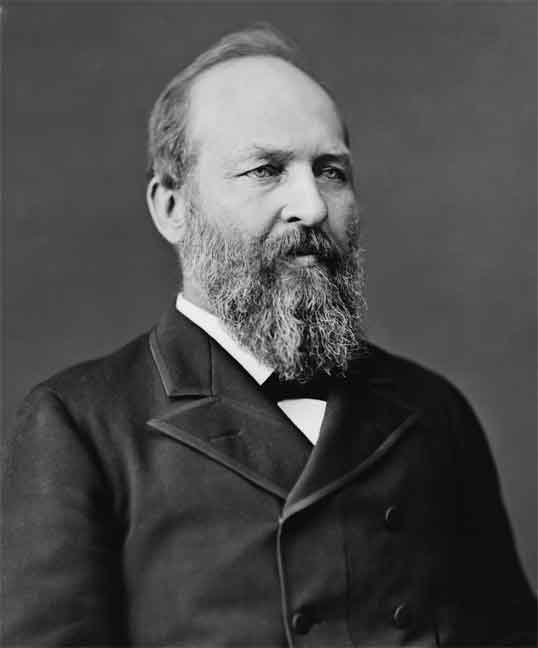
In office March 4 — September 19, 1881 · Republican
A self-made scholar and Civil War general, Garfield was shot by a disappointed office-seeker just months into his term. He lingered for eleven weeks before dying — and his death gave new urgency to civil-service reform. Elected 1880 →
Born
Nov 19, 1831Moreland Hills, OH
Died
Sep 19, 1881Elberon, NJ
Party
Republican
Vice President
Chester A. Arthur
First Lady
LucretiaGarfield
War
None
James Garfield
Garfield's term as President was cut short by his assasination, committed by a rebuffed job seeker. He did not die immedietly, but lingered on, wounded, for two and a half months.. Elected 1880
Watch — James A. Garfield in brief
The Early Years
Garfield was born in a log cabin in Cuyahogo County, Ohio. His father died when Garfield was 18 months old. He was a precocious child who learned to read by the age of 3 years old. Garfield attended elementary school at the local district school. He went on to attend the Geauga Academy in Chester, Ohio and the Eclectic Institute in Hiram, Ohio. He worked his way through school by teaching younger students and working as a janitor. In 1854, Garfield entered Williams College in Williamstown, Massachusetts as a junior. He graduated with honors in the class of 1856.
Upon graduation from Williams, Garfield returned to the Eclectic Institute first as an instructor and then, from 1857-1861, as the President of the Institute. During this period, Garfield studied law and was admitted to the bar in 1860. He was also an Ohio State Senator from 1859-1861. As a State Senator, he took a strong stand against slavery.
Garfield was commissioned a lieutenant colonel in the Union army in August 1861. He rose to the rank of Major General. He saw action in several battles, and acquitted himself well.
In 1862, Garfield was elected to Congress. Thus, in 1863, he resigned his army commission and took up his house seat. Garfield was among the most radical Republicans in the House, and called for stronger action against the Confederacy. After the war, he moderated his views, but still supported the impeachment of Johnson. Garfield was a leading House member, who dealt with financial members, and served at different times as Chairman of the House Banking and Currency Committee, Appropriations Committee and as a member of the Ways and Means Committee.
Accomplishments in Office
Garfield's administration was cut short by his assassination on July 2. Before his assassination, Garfield's efforts were mostly devoted to resolving issues of political patronage. Garfield was assassinated by Charles Guiteau, a Garfield supporter who had been denied a political appointment. Garfield was gunned down in the waiting room of the Baltimore and Potomac Railroad in Washington. He died of blood poisoning on September 17th, two months after he was shot.
From the makers of HistoryCentral
Explore our history apps
Take HistoryCentral with you. Our apps put American history and centuries of the human story in your pocket.