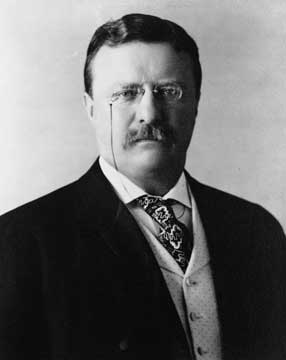
In office September 14, 1901 — March 4, 1909 · Republican
The youngest man ever to become president, the dynamic Roosevelt busted trusts, built the Panama Canal, protected millions of acres of wilderness, and won the Nobel Peace Prize for helping to end the Russo-Japanese War. Elected 1904 →
Born
Oct 27, 1858New York, NY
Died
Jan 6, 1919Oyster Bay, NY
Party
Republican
Vice President
Charles W. Fairbanks
First Lady
EdithRoosevelt
War
None as president
Theodore Roosevelt
Roosevelt was 42 years old at the time of his inauguration. His major accomplishments were creating the National Parks, fighting monopolistic companies, and asserting the United States in its foreign policy.. Elected 1904
Watch — Theodore Roosevelt in brief
The Early Years
Theodore Roosevelt was born in New York City. Roosevelt was a sickly child who suffered from asthma. As a child, he developed an early interest in wildlife and hoped to become a zoologist. He traveled extensively with his family and as he was too sick as a child to go to school, he was taught by private tutors. In 1875, at the age of 17, Teddy Roosevelt took and passed the Harvard entrance exam. He began his studies the next year.
A year after graduating from Harvard and beginning Columbia Law School, Roosevelt left school to run for the New York State Senate. He won and served for two years. After this, Roosevelt worked as a cattle rancher in the Dakota Territory for two years and was for a short period a Deputy Sheriff of Billings County.
From 1889 to 1895, Roosevelt served on the Commission of the US Civil Service. He vigorously worked to ensure strict enforcement of the Civil Service laws. From 1895 to 1897, Roosevelt served as President of the New York City Police Board. From 1897 to 1898, Roosevelt served as the Assistant Secretary of the Navy. He was a strong supporter of the war with Spain.
When the war began, Roosevelt resigned his post to become Commander of the US Volunteer Cavalry Regiment, otherwise known as the "Rough Riders." He led a charge up San Juan hill and became famous throughout America.
From 1898-1900, Roosevelt served as the Governor of New York. In the fall of 1900, Roosevelt was nominated Vice President on a ticket with President McKinley after the death in office of Vice President Garret Hobart. On McKinley's death, Roosevelt became the youngest man to assume the office of President.
Accomplishments in Office
Theodore Roosevelt was one of the most vigorous men to enter the White House. Not only was he young in years, he was clearly a man of action, and this set the tone for his Presidency.
Roosevelt carried out a vigorous foreign policy. He tried to negotiate an agreement with Columbia (which at the time was part of Panama) to allow the building of the Panama Canal. When the Columbians refused, a rebellion began in Panama. The United States immediately recognized the triumphant new Columbian-Panamanian government, which quickly negotiated a canal treaty.
Roosevelt's legacy was further solidified with the addition of what became known as the Roosevelt Corollary to the Monroe Doctrine. This significant addition declared the United States' responsibility to intervene in South America in the event of instability, a policy that would shape the region's geopolitics for years to come.
Roosevelt's diplomatic prowess was on full display when he successfully mediated the Russian-Japanese war. His efforts in brokering peace were so significant that he was awarded the Nobel Peace prize, a testament to his commitment to global stability.
Roosevelt was also very active in domestic affairs. He pursued a strong policy of enforcing antitrust laws, and his administration brought antitrust actions against a wide range of monopolist corporations. Roosevelt intervened on the side of miners in the coal strike of 1902. He also strongly supported the first federal law to provide for the inspection of meats, drugs, and other substances.
Roosevelt earned a reputation as a great conservationist for his action in setting aside 125 million acres for national forests.
From the makers of HistoryCentral
Explore our history apps
Take HistoryCentral with you. Our apps put American history and centuries of the human story in your pocket.