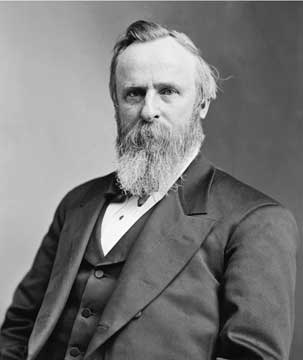
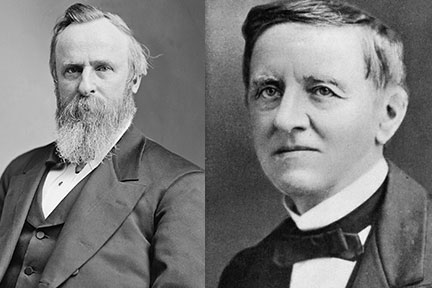
Rutherford Hayes was nominated on the seventh ballot at a hotly contested Republican convention in 1876. The Republican platform called for the continued control of the South, civil service reform, and investigation of the effects of Oriental immigration. The Democrats called for the end of reconstruction in the South, restriction of Oriental immigration and an end to land grants for railroads.
The two candidates were both experienced if dull. Hayes had been a General during the Civil War, had a law degree from the Harvard Law School and was governor of Ohio. The Democratic candidate Samuel Tilden had been a district attorney fighting corruption in New York, where he became governor. The campaign revolved around the issue of corruption. The Democrats accused Hayes of the crimes of the Grant administration. At the same time, the Republicans continued to call the Democrats the party of treason. In the final days of the campaign, Tilden was regarded as the favorite, and even Hayes believed that he had lost.
Tilden won more votes than Hayes, but returns in three states, South Carolina, Florida, and Louisiana were disputed. Tilden was one state short of victory. Congress appointed a congressional committee to investigate. The committee decided to award all the disputed votes to Hayes. Hayes, in return, however, promised to end reconstruction. Hayes became the next President.